Harvest and Drying
Harvest Timing

Harvest does not begin on a fixed date.
It begins when ripeness is consistent enough to justify selection.
Coffee cherries are picked in multiple passes.
Unripe or overripe fruit is left behind.
Selection
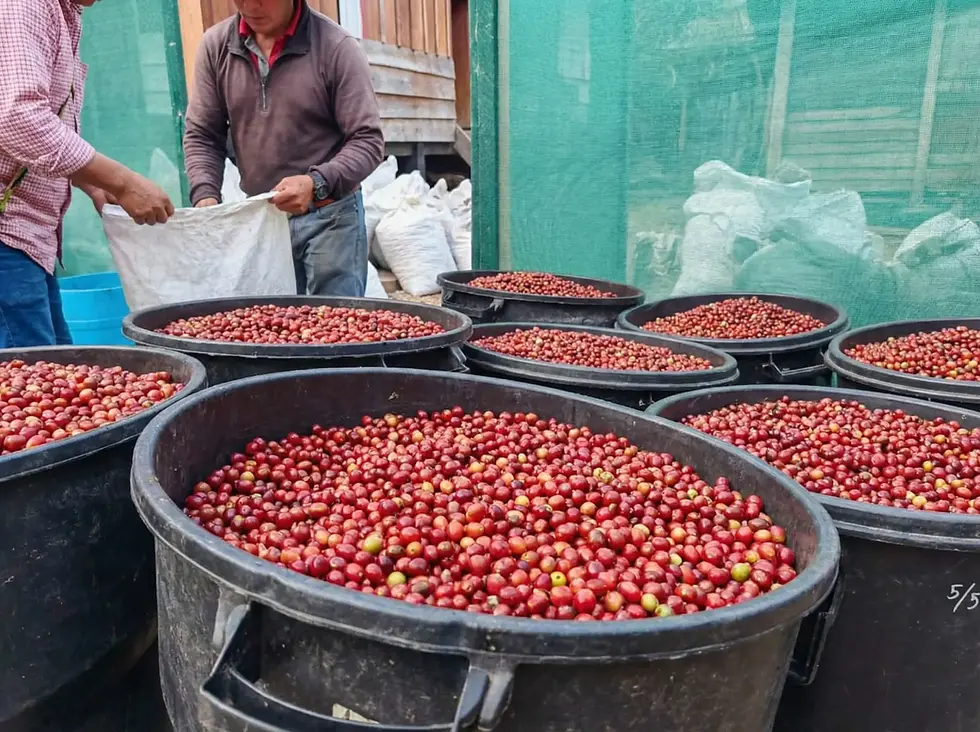
Selection begins before harvest is complete.
Only fully ripe cherries are picked.
Unripe fruit remains on the tree.
Defective cherries are removed immediately.
After harvesting, further selection follows.
Cherries are separated by density and condition.
Only first-grade coffee is kept.
Volume is reduced at every step.
Yield is intentionally sacrificed to protect consistency.
Drying Decisions

Drying is not treated as a single method.
It is adjusted continuously based on weather, humidity, and batch size.
Raised beds, covered structures, and mechanical dryers are used when required.
The choice depends on conditions, not preference.
The goal is stability.
Not speed.
Control and Reaction

Drying is not a passive phase.
It requires constant observation and comparison.
Moisture levels change with temperature, cloud cover, and airflow.
What dries evenly one day may stall the next.
Each lot is checked repeatedly — by touch, by smell, by sound.
Beds are turned, shaded, or covered only when necessary.
Intervention is not standardized.
It responds to conditions as they unfold.
Control here does not mean forcing an outcome.
It means recognizing when to act — and when not to.
Consequences
Every decision made during harvest and drying has consequences.
Reducing moisture too quickly can flatten acidity.
Drying too slowly risks instability and defects.
Inconsistency early is amplified later
For that reason, volume is reduced deliberately.
Lots that do not respond as expected are separated.
Some are held back.
Others are discarded entirely.
Yield is sacrificed to protect structure, clarity, and longevity.
Not every harvest becomes coffee.
Not every coffee becomes a release.
This process does not optimize for efficiency.
It optimizes for repeatability and trust.
What remains is not the result of chance.
It is the outcome of timing and restraint —
decided long before roasting or sale.
Harvest and drying do not add character.
They preserve it.
This is where quality is decided —
quietly, early, and without compromise.

